Technology

Ajay on the future of Tech at Google
Ajay on the Metaverse at the Economist
Ajay at the Independent Publishers Guild

Ajay on the Future of Work at Worktech


A founder of the iconic music recognition app Shazam has said businesses must deploy artificial intelligence (AI) in online shopping, or risk losing out to powerful e-commerce forces like Amazon and Shopify.
Retailers who fail to adopt AI may find themselves at a significant disadvantage, particularly in an increasingly competitive and tech-savvy market, Ajay Chowdhury, the lead founding investor in Shazam in 2000 and chairman of the company for seven years, told City A.M.
“We’re certainly recommending to all our clients that they start experimenting with this. And you will get left behind if you don’t do it,” said Chowdhury, now a managing director at Boston Consulting Group.
Chowdhury said the likes of Amazon are already thinking about a more “conversational” style of shopping to drive sales. A search bar could act as a personal shopping assistant, asking questions about what a customer wants before providing a tailored suggestion.
“Generative AI is a fantastic tool to really provide personalised shopping recommendations. What it can do is analyse your browsing history, analyse your purchase history and very quickly come up with really unique recommendations,” explained Chowdhury.
It goes beyond personalised recommendations. Other potential AI uses for retailers include improved customer service, fraud detection and more streamlined operations, like optimising supply chain routes and managing inventory more efficiently.
Embracing AI will come at a steep price. “If businesses want to do it at scale it’s not cheap, because when you use Gen AI, it’s constantly going back to the cloud, which uses a lot of computing power,” he warned.
But the cost of ignoring it could be higher. “There will absolutely be an early mover advantage.” Prices are also likely to come down over time, he said.
On top of that, there are “massive ethical implications”, including regulatory, copyright and security concerns. Companies need a responsible AI policy in order for customers to trust them and because there will be some exploring ways to game the system.
Businesses need to be “slightly careful in whether they go hell for leather to do this, but they have to start working on it now. They have to start experimenting.”

The author embracing AI to help write novels – and why he’s not worried about it taking his job
For many writers, AI poses an existential threat to their livelihoods – but one author believes the technology could help drive him and his fellow creatives to new heights.
By Tom Acres, technology reporter
Saturday 19 August 2023 02:32, UK
The rain tapped lightly against the windowpanes of my London apartment, a steady rhythm that mirrored the musings within my little gray cells.
It was a day like any other, or so I believed, until a peculiar letter arrived. As I delicately unfolded the note, its contents gave rise to a most intriguing puzzle.
‘Mr Hercule Poirot,’ it began in elegant script, ‘I implore you to lend your unparalleled expertise to a matter of utmost secrecy and importance.
‘An enigma of art, an amalgamation of shadows, a crescendo of whispers, await your perceptive insight.’
Asked to open a new novel starring detective Hercule Poirot, one of Agatha Christie’s most famous creations, that’s ChatGPT‘s first attempt at grabbing your attention.
Ciphers Of The Midnight Mind is the artificial intelligence (AI) chatbot’s suggested title – and it could no doubt craft the entire rest of the story in a matter of seconds.
For fans of the more than century-old character, whose popularity has endured beyond Christie’s death in 1976, new stories composed on demand may be a tantalising prospect.
After all, the author’s estate – like those who hold the keys to James Bond and Sherlock Holmes – has happily commissioned other writers to give readers new Poirot and Miss Marple adventures. Who’s to say those same fans couldn’t find enjoyment in a passable imitation by AI?
For many writers, it’s an existential question that has them fearing for their livelihoods.
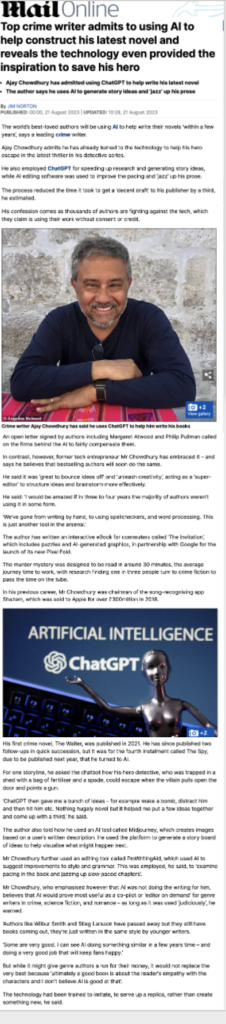
But for Ajay Chowdhury, an award-winning crime author, it presents an opportunity for them to reach new heights.
“There’s a lot of fear around it for a writer – but I don’t believe it is going to replace us,” he says.
“I started experimenting with AI in writing six or seven months ago, and it was of course slightly scary.
“But it’s like having a fantastic editor on demand.”
Useful editor or existential threat?
Chowdhury’s fascination with AI speaks to his background in tech, one which included co-founding the music discovery app Shazam, later bought by Apple for a reported $400m (then £300m).
But he is now known for his Kamil Rahman crime series, inspired by his Indian roots, which has won him several awards and will see a fifth entry – The Spy – released next year.
AI tools are playing a key role in its development – helping Chowdhury bounce thoughts around, generate potential outcomes for certain scenes, and rephrase sections to help with pacing.
He even used an image generator, Midjourney, to visualise a dramatic chase scene through a cave on the island of Elephanta, a world heritage site off the coast of Mumbai. It helped spark ideas about how it could play out.
“Eight out of 10 times, whatever AI gives you might be thrown away, but the other two times you might think it’s a decent idea that can be expanded on,” he says.
“Using a combination of these tools is giving me a much better draft to submit. I am finding that I get to what would have been a fifth draft by the second draft.”
For Chowdhury, there’s no shame in using AI to help get there, despite what many of his contemporaries fear.
Earlier this month, author Jane Friedman had to contend with AI-generated books purportedly written in her name, falsely listed as such on Amazon. She managed to have them removed, despite them not technically falling foul of copyright law because she had not trademarked her name.
“This promises to be a serious problem for the book publishing world,” she warns.
‘Marvel formula’ most at risk
More than 100,000 writers have endorsed an open letter by America’s Authors Guild, which has demanded AI’s development show “respect for human creators and copyright”.
Generative models like ChatGPT are trained on huge amounts of trademarked material, prompting writers including comedian Sarah Silverman to sue its creator OpenAI for copyright infringement.
This potential to imitate human work is a driving force behind ongoing writers’ strikes in Hollywood.
TV and theatre writer Lisa Holdsworth, who is chair of the Writers’ Guild of Great Britain, told the Sky News Daily podcast that would constitute theft more than creation, and the longer AI models are left to be trained without safeguards in place, “the more of a threat it becomes”.
Chowdhury backs the cause, saying left to its own devices, AI will only serve to indulge mediocrity.
“That beige world of creativity where everything is sequel 32 to something, that worries me,” he admits.
“Look at films like Oppenheimer and Barbie, both extremely well written. Could AI create those? No. But could they write the next Marvel? Possibly, it’s a pretty clear formula.”
A world of mediocrity?
For Chowdhury, the genie is out of the bottle and there’s no going back – writers, like all of us, need to adapt.
Aside from the next main entry in his Kamil Rahman series, AI helped Chowdhury find time to work with Google on interactive novel The Invitation, a crime story set in London’s East End.
The free short story – which includes puzzles to solve, a countdown timer, and sound effects – was made with commuters in mind and only takes around 20 minutes to get through.
It’s a little heavy on the Google product placement, with nods to Gmail and Maps that are clever or eye-rolling depending on your level of cynicism, though as a proof of concept for quick to make, accessible interactive novels, the kinds of which gamers have long been familiar, overall it’s quite effective.
The whole thing came together in six weeks to mark the UK launch of the tech giant’s new Pixel Fold phone, optimised to take advantage of its book-like screen. The production speed helped by Chowdhury generating the artwork using Midjourney.
It does the job, but it’s a move that will no doubt rub some the wrong way given the criticism levelled at Marvel for using AI to generate opening title graphics for its latest TV series.
But Chowdhury still sees AI as a tool to take him and others “to another level”.
“The utopia to me is people using AI to enhance their creativity,” he says.
“The side that worries me is if large corporations start to think we don’t need creatives any more.
“That will become a world of mediocrity.”
As the rain continued to dance its elegy on the windowpane, Poirot leaned back in his chair, his little gray cells still whirring with satisfaction.
For within the labyrinthine corridors of art and deception, he had once again illuminated the truth, dispelling the shadows that sought refuge in the enigmatic corners of the human soul.
Thanks, ChatGPT, but when it comes to Poirot, I think I’ll stick with Christie.


There’s a huge momentum towards investing in generative AI at the moment globally. In the fashion industry in particular, big brands are increasingly making headlines announcing trials of AI-powered technology, and at Web Summit 2023’s opening ceremony on Tuesday night, AI in fashion was highlighted as a key topic.
But are we really moving towards a future where we will be surrounded by AI imagery, or is it a fantasy?
Trials of virtual try-on changing-room technology, where users can view a 2D or 3D image of themselves wearing a garment, have existed since at least 2019, but are picking up pace.
Ajay Chowdhury, senior partner at the Boston Consulting Group, is a former venture capitalist who co-founded the popular AI music-recognition app Shazam.
“For a 2D static image in a magazine, it’s very doable – licensing model IP is definitely happening. But 3D avatars in virtual changing rooms or in a video ad? Not for a long time,” he says.
Mr Chowdhury says the key difficulty is that no retailer has a giant database of their clothes and how the fabrics drape on different bodies, which is essential to make a virtual changing room with 3D avatars work.
UK retail expert Kate Hardcastle is currently working with technology partners in the US who are developing AI for the retail industry, acting as an advisor on what consumers want from their retail experience, and providing a sanity check on AI ethics with a focus on protecting consumer interests.
Lots of retailers want to trial virtual try-on dressing rooms and AI-generated models, says Ms Hardcastle, but when the trials end, that’s it.
“Brands are really intrigued by the potential of AI in retail, but no-one is paying out,” she tells the Standard.
“Since 2020, the explosion of competition and second-hand shopping has significantly impacted the resources the fashion industry has to develop new solutions.”
Ms Hardcastle has visited concept “stores of the future” which use AI connected to smartphones and in-store billboards showing products personalised to each consumer as they walk into the store.
“Everything, from the price tag, sizing availability, through to the changing room and checkout, was a personalised conversation with the consumer,” she says.
“It was like a white-glove AI concierge experience.”
Instead, she and Mr Chowdhury are seeing AI being implemented to automate and improve stock-inventory systems, manufacturing supply chains, and sustainability – things that don’t sound anywhere near as sexy as AI fashion models.
They both agree that the only way you could gather enough data on consumers’ bodies is to put cameras in store dressing rooms, and there’s no chance that’s going to be happening, due to privacy concerns.
“I’ve just run a big AI study in the summer [for Gartner]. We interviewed 35 companies, collected more than 100 use cases,” says Ms Zimmermann.
“I can count with one hand the number of retail-use cases and that could probably say that the retail industry, from a generative AI or VR/AR perspective, is not very mature yet.”


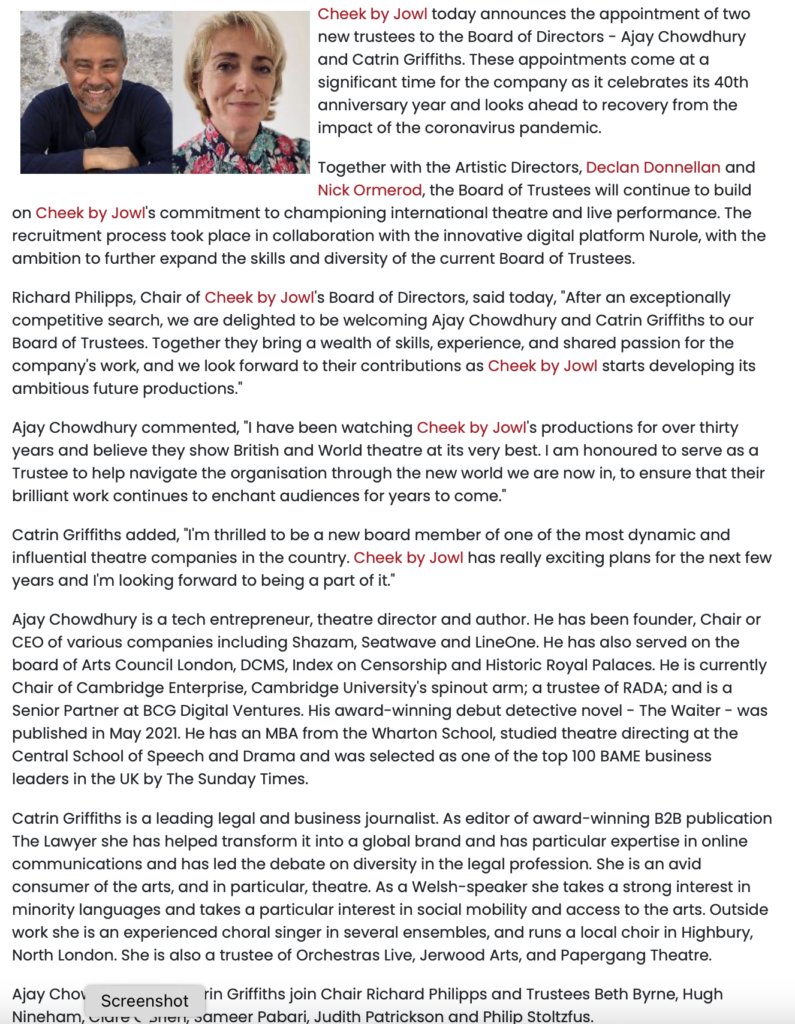



Ajay Chowdhury named Chair of Cambridge Enterprise Board
Cambridge Network
Ajay Chowdhury has been named Chair of the Board of Cambridge Enterprise. He assumed leadership of the Board in January, overseeing the strategy of Cambridge Enterprise, which is tasked with supporting the commercialisation of the ideas that emerge from the University.
Chowdhury has 25 years of start-up venture experience, building disruptive, new digital businesses in a wide range of industries.
He has particular expertise in mobile, e-commerce, digital media, data analytics, digital retail and government as well as strong functional expertise in sales, strategy development, product development and fund raising.
Chowdhury is Partner and Managing Director in the London office of BCG Digital Ventures. Prior to joining BCG, he was CEO of Seatwave, a European online ticketing marketplace that was sold to Ticketmaster. Before joining Seatwave he was CEO of ComQi, a global omni-channel retail technology company that was sold to AU Optronics.
Chowdhury was a founding partner of IDG Ventures Europe, a $100 million European venture capital fund. He also served as Chairman of Shazam, a $1 billion mobile audio recognition company and invested in and served on the board of Lionhead, a games developer sold to Microsoft.
Selected as one of the Asian Power 100—the 100 most influential and powerful Asians in the UK— Chowdhury has also been recognised with the 2015 Dealmaker of the Year award from M&A Magazine, Top 100 Asian tech stars and selected as one of 2016’s Sunday Times top 100 BAME business leaders in the UK.
Chowdhury has an MBA from the Wharton School of the University of Pennsylvania. He serves on the board of the UK Government’s Department of Culture, Media and Sport.
Professor Andy Neely, Pro-Vice-Chancellor for Enterprise and Business Relations, said: “Cambridge Enterprise has played a critical role in the development of the Cambridge cluster, supporting a wide array of University spin-outs and start-ups. As digitalisation continues at pace, Ajay’s background and experience will be invaluable to Cambridge Enterprise and the wider University.”
Chowdhury said: “I am delighted to be joining Cambridge Enterprise as its Chair. Knowledge exchange and technology transfer are important and increasingly vital parts of the mission of universities in general. The University of Cambridge is amongst the most important university sources of new deep tech ventures and promising therapeutics in the UK and internationally.”
Tony Raven, CEO of Cambridge Enterprise, said: “We are indebted to our outgoing Chair, Sir Keith O’Nions for his role in the development of the organisation and the Board over his five-year tenure. We look forward to welcoming and working with Ajay.